Why the Birman Is Not the Same as the Burmese
A Birman and a Burmese can sound like two versions of the same cat, but they are distinct breeds with different coats, markings, body types, and histories. The confusion is understandable: both have warm, people-focused reputations, and their names differ by only a few letters. This guide explains how to tell them apart and what those differences mean for everyday life with either cat.
The clearest differences between a Birman and a Burmese
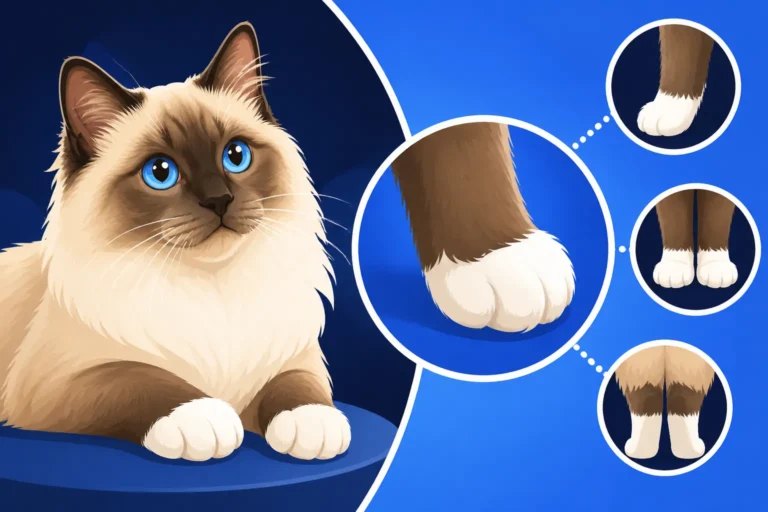
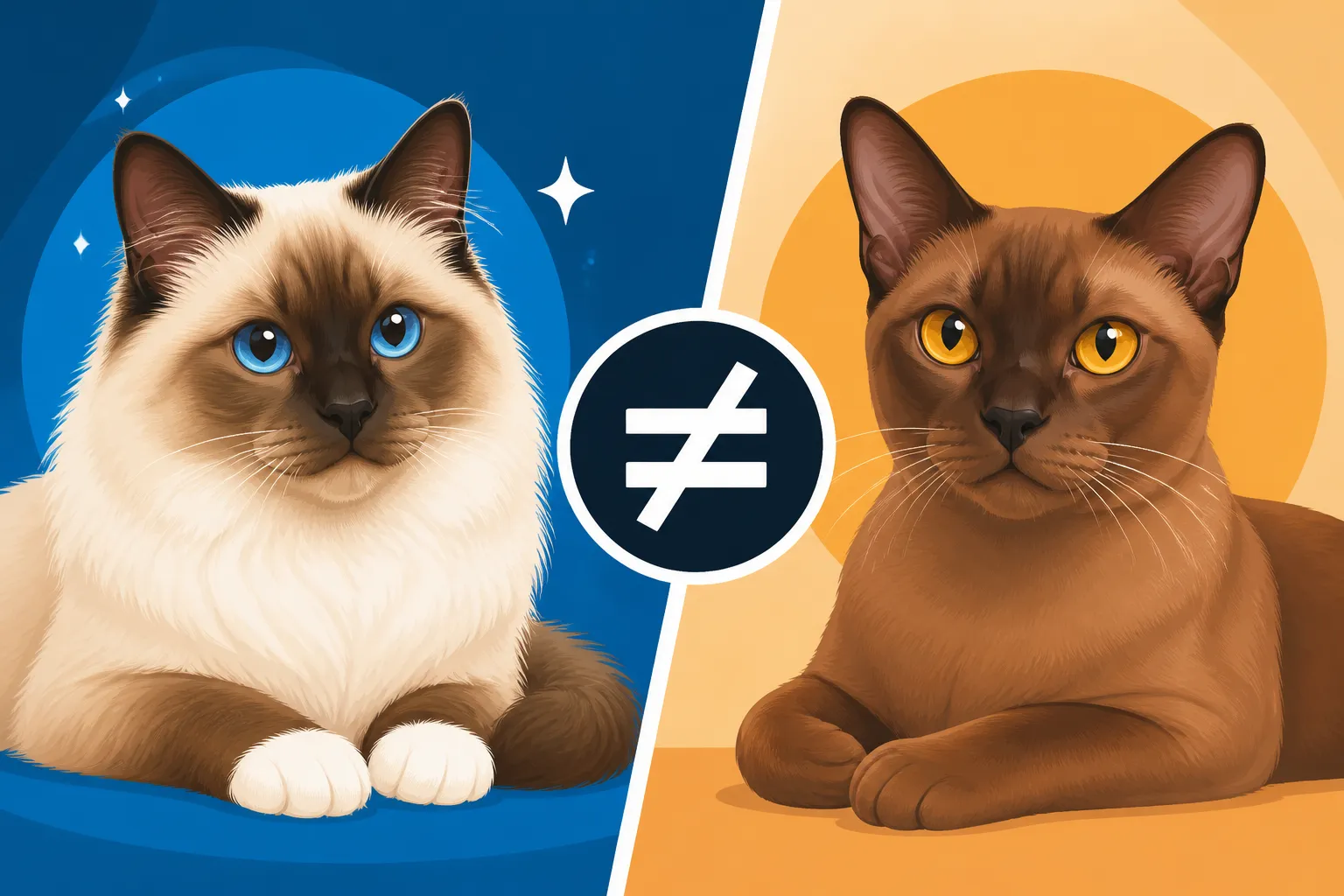
The quickest way to distinguish these breeds is to look at the coat and paws. A Birman is a longhaired, pointed cat with blue eyes and white feet called gloves. A Burmese has a short, close-lying coat, no Birman-style white gloves, and typically gold to yellow eyes. Their names may be similar, but their signature looks are not.
| Feature | Birman | Burmese |
|---|---|---|
| Coat | Semi-long, silky, usually without a dense woolly undercoat | Short, fine, close-lying |
| Color pattern | Pointed: darker face, ears, legs, and tail against a paler body | Burmese sepia pattern: color is more evenly spread, with subtle shading |
| Paws | Distinctive white gloves on all four paws | No breed-defining white gloves |
| Eyes | Blue | Usually gold to yellow |
| General build | Medium to large, sturdy, with a long rectangular outline | Medium-sized, muscular and compact-looking |
| Grooming | Regular combing, especially around the ruff and hindquarters | Light routine grooming, with less coat to manage |
| Breed origin story | A European breed with a temple-cat legend that is not established history | Developed from a cat named Wong Mau brought from Burma to the United States |
Coat, color, and the white gloves
A Birman’s coat is one of its most recognizable features. The body is pale, while the face, ears, legs, and tail have darker points. Those points can appear in several colors, including seal, blue, chocolate, and lilac, depending on the registry and variety. The feet are white, and the eyes are blue. The contrast between the points and the body can deepen with age or cooler conditions, so a kitten’s coat may look different from an adult’s.
The white paws are not simply random white markings. The breed’s characteristic gloves are an important part of its appearance, and show standards assess their placement and shape. A Birman’s front gloves should be even, while the back feet have white markings often described as laces. The details can be subtle, which is why two Birmans may look similar at a glance but differ in how their feet are marked. For more on the feature that sets the breed apart, see What Judges Look For on a Birman's Paws First.
A Burmese has a very different color effect. Its coat is short and close to the body, and the color is more evenly distributed rather than sharply concentrated at the points. Burmese coat colors vary by registry and region; common examples include sable or brown, blue, chocolate, and lilac. Even when a Burmese has darker shading around the face or limbs, it does not have the Birman’s classic pale body, blue eyes, and four white gloves.
That difference can be helpful when you are looking at kittens. Both breeds may change in appearance as they grow, but you should not expect a Burmese kitten’s paws to develop into Birman gloves or its eyes to become the breed-standard Birman blue. A useful comparison is Why a Birman Is Always Pointed and Never Solid.
Body shape and facial features
Birmans are substantial cats with a sturdy frame and a long, balanced outline. Their coat can make them look especially broad, but they are not just a ball of fluff: the body beneath the fur is solid and elongated. Their faces are rounded without the very flat profile associated with some other longhaired breeds. The blue eyes, full coat, and white feet together create a distinctive overall look.
Burmese cats are also muscular, but they usually appear more compact. Their short coat follows the body, making their build easier to see. Depending on the type and standard, Burmese can look more rounded or more athletic, but the coat does not create the same flowing outline as a Birman’s ruff, britches, and tail plume.
When comparing cats in person, look at more than size. A fluffy cat can appear larger than it is, and individual cats vary in weight and proportions. Check the shape of the coat, the eye color, and the feet as a group of clues. If you are trying to compare a Birman with another pointed longhair, How to Tell a Birman From a Ragdoll by Its Feet explains why the paws are such a useful detail.
Grooming needs are not the same
A Birman’s silky coat generally needs regular combing to prevent tangles, particularly behind the ears, under the legs, and around the hindquarters. It may look demanding, but many owners find it more manageable than a very dense, woolly coat. Gentle, steady sessions help remove loose fur and give you a chance to notice a new mat or skin irritation before it becomes harder to handle.
A Burmese has less coat to comb. A soft brush or grooming mitt can help remove loose hair, and routine checks of the nails, ears, and teeth still matter. The shorter coat does not make a cat maintenance-free, but it usually means less time working through long fur.
If you shop for grooming supplies online, Chewy is one place to compare combs and brushes, but choose a tool for the individual cat’s coat rather than its breed name alone. A fine-toothed comb that works comfortably through a Birman’s silky coat is not necessarily the best choice for every cat, and a short-coated Burmese may need only a gentle grooming tool. For practical coat care, see No Undercoat Is What Makes a Birman Easy to Groom.
Their histories are different too
The names do not point to one breed being a shorthaired version of the other. Birman and Burmese are separate breeds with different development stories. A breed’s origin can be muddied by legend, later breeding, and changing registry records, so it helps to separate popular stories from the parts of the history that are more firmly documented.
The Birman’s legend and European development
The Birman is often called the Sacred Cat of Burma. A popular legend connects the breed with temple cats and explains its white paws as a sacred mark. It is a memorable story, but it should be understood as legend rather than proof that modern Birmans descend directly from a documented population of temple cats.
The breed as known today was developed and established in Europe. Its history includes accounts of cats arriving in France and subsequent breeding there. The breed’s name and striking appearance have helped keep the Burma temple story alive, but the legend and the documented development of the modern breed are not the same thing. You can explore the story and its limits in The Birman Is the Sacred Cat of Burma, and the Story Is a Legend.
Birman breeding was also disrupted by the Second World War, and breeders had to rebuild the population afterward. That history matters because it helps explain why the breed’s modern development is more complicated than a simple tale of ancient cats carried unchanged from one place to another. For more context, see The Birman Came Out of the War With Two Cats Left.
The Burmese developed from Wong Mau
The Burmese breed’s modern history is commonly traced to Wong Mau, a cat brought from Burma to the United States in the early twentieth century. Breeding programs developed from her and other cats, including crosses with Siamese cats. Over time, breeders selected for the Burmese coat, body, and other distinctive traits, and the breed became recognized separately.
That story is different from the Birman’s. The Burmese name reflects the cat’s association with Burma, but it does not mean that the breed is a Birman or that it shares the Birman’s signature gloves and pointed coat. Nor should the two names be treated as interchangeable labels for Burmese-origin cats.
The breeds can share broad traits, such as an interest in people, without sharing the same ancestry or breed standard. If someone tells you a Burmese is “basically a shorthaired Birman,” that is an oversimplification. They are separate breeds, and their histories and defining features should be considered separately.
Why the names are easy to mix up
“Birman” and “Burmese” are visually similar words, and both are associated with Burma in popular descriptions. That is enough to trip up new cat owners, especially when a listing uses vague language such as “Burmese-type” or “Birman mix.” Similar names do not establish a cat’s breed, pedigree, or appearance.
A cat with a long coat and blue eyes is not automatically a Birman. A cat with a short brown coat is not automatically a Burmese. Breed identification depends on a combination of traits, and a pedigree from a recognized registry is different from a visual guess. If you are considering a kitten, ask the breeder or rescue organization what documentation is available and what they mean by the breed label.
It is also worth remembering that registries may use different naming conventions for colors and types. The broad contrast remains useful: Birmans are longhaired, blue-eyed, pointed cats with white gloves; Burmese are shorthaired cats with a more even sepia coat pattern. For more on the Birman’s postwar development, see Which Longhairs Rebuilt the Birman After 1945.
What living with each breed may feel like
Breed descriptions can help you set expectations, but no breed label guarantees a particular personality. Early handling, health, age, household routine, and the individual cat all matter. Both breeds are often described as people-oriented, but their personalities should be assessed as individuals rather than assumed from appearance.
Social behavior and companionship
Birmans are often described as calm, affectionate companions who like being near their people. Some follow family members from room to room; others prefer to settle close by without being carried or held for long. Their reputation for gentleness does not mean every Birman is quiet or equally sociable. A kitten’s behavior, the breeder’s socialization practices, and the home environment all help shape how comfortable the cat feels.
Burmese cats are also known for forming strong social connections and may seek a good deal of interaction. Some are playful and persistent about getting attention, while others are more relaxed. If you are away from home for long stretches, think about how much companionship the particular cat appears to need, not just what a breed profile says. A second compatible pet can help some cats, but introductions should be gradual and based on both animals’ temperaments.
For either breed, watch the cat in a real setting if possible. Does it approach people willingly? Does it recover after a new sound or visitor? Does it play, explore, and settle comfortably? Those observations can tell you more than a simple claim that a breed is “good with everyone.” A Birman’s people-focused habits are discussed in Why a Birman Follows You Without Demanding Anything.
Activity and play
A Burmese may be a lively, interactive companion, and some enjoy games that involve chasing, climbing, or solving a food puzzle. That does not mean every Burmese is constantly energetic, but prospective owners should be ready to provide play and attention. Short sessions with a wand toy or a rotating selection of safe toys can give an indoor cat something to do without turning the home into an obstacle course.
Birmans often enjoy play as well, though many owners describe their activity level as moderate. A Birman may chase a toy, investigate a new box, or join a household routine, then settle nearby. Give any cat places to rest, scratch, and observe the household. A cat tree is not a substitute for interaction, but vertical space and a window perch can add useful enrichment.
When buying toys or puzzle feeders, Chewy can be a convenient retailer to browse, but focus on safe construction, the cat’s play style, and whether the item is easy to clean. Start with simple options before buying a large collection. A cat that ignores a toy may prefer a slower-moving wand or a short game at a different time of day, not a more expensive product.
Choosing the right breed and avoiding misidentification
The right choice depends on the kind of care you enjoy, the time you can offer, and the particular cat’s needs. Appearance can narrow your search, but it should not be the only deciding factor. Both breeds need attentive care, a safe home, and veterinary support.
Match the coat to the care you can provide
If you love the look of a long, silky coat and are comfortable with regular combing, a Birman may suit your routine. Keep a comb where you can reach it and build short grooming sessions into the week. It is much easier to prevent small tangles than to deal with a tight mat after it has formed. A calm routine, treats, and gentle handling can help make grooming feel ordinary rather than like a battle.
If you prefer minimal coat care, a Burmese may be more appealing. Its short coat is simpler to maintain, but the cat still needs nail checks, dental care, play, and routine health visits. Short hair should not be confused with low emotional or medical needs. A cat can be easy to brush and still require plenty of attention.
Consider your household realistically. If you travel often, work long days, or have young children, think through the practical arrangements before choosing either breed. Ask about the cat’s known temperament, how it handles being alone, and what support it has received during early socialization. A thoughtful match is more important than choosing the breed with the most appealing description.
Check records rather than relying on a photo
If a breeder advertises a kitten as a Birman, ask for its pedigree and registration details, and confirm what documents will come with the kitten. Ask about health screening relevant to the line and whether you can review the results. A photo can show coat length and markings, but it cannot confirm pedigree or establish that a cat is free of inherited health problems.
When considering a Burmese, use the same careful approach. Ask for documentation, details about the parents, veterinary records, and the breeder’s policy for answering questions after the kitten goes home. Avoid pressure to pay quickly before you have had a chance to understand what is included. A responsible source should be willing to explain the cat’s background in clear terms.
If the cat is a rescue or a mixed-breed companion, a formal pedigree may not be available—and that does not make the cat less worthy of a home. In that case, focus on its known medical history, behavior, and care needs. If you need supplies while preparing, Chewy can help you compare basics such as litter, a carrier, grooming tools, and toys, but your veterinarian’s advice should guide food and health decisions. For a broader guide to choosing this breed, see Who the Birman Actually Suits.
Use the simplest identification checklist
When you are unsure which breed you are looking at, ask these questions:
- Is the coat long or short? A Birman has a semi-long coat; a Burmese has a short, close-lying coat.
- Are the eyes blue or gold to yellow? Blue eyes are a defining Birman feature; Burmese eyes are typically gold to yellow.
- Are all four paws distinctly white? Birman gloves are a signature trait. White paws alone do not prove pedigree, but the pattern is a useful visual clue.
- Is the color pointed or more evenly distributed? Birmans have a pale body with darker points. Burmese coats have a more even sepia effect.
- Is there pedigree documentation? Appearance can suggest a breed, but records are needed to establish pedigree.
These clues make an initial comparison easier, but a photograph may hide coat texture, eye color, or the exact shape of the feet. If the answer matters for a purchase or breeding decision, ask for documentation rather than relying on appearance alone. And if you are simply choosing a companion, focus on the cat in front of you: its health, temperament, and needs matter more than whether its name is easy to confuse.
Disclaimer
This article is for general informational purposes only and does not constitute professional advice. Laws, prices and regulations vary by location and change over time. Consult a qualified professional for guidance on your specific situation.