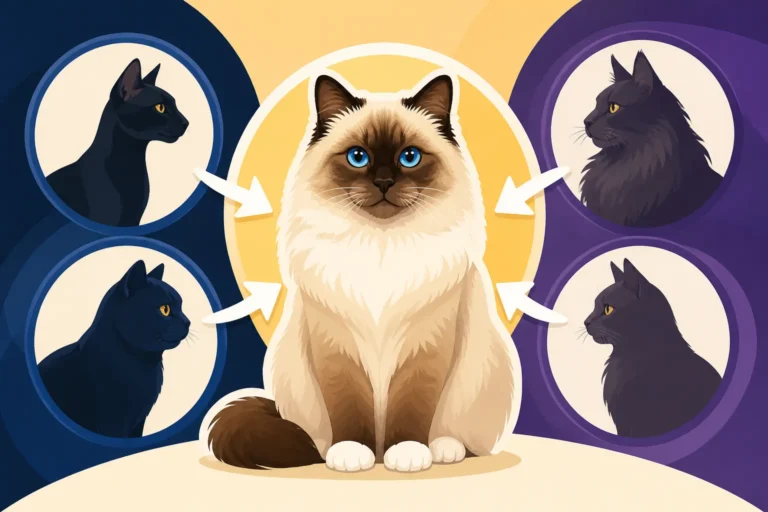
Why a Himalayan Has No Gloves and a Birman Does
It’s a common sight to see beautiful pointed cats, those with darker extremities, and wonder about their lineage. Many of these gorgeous felines share striking color patterns, but have some key differences that truly set them apart. One of the biggest points of confusion, and one we hear about a lot, is how to distinguish between a Birman and a Himalayan, especially when it comes to those distinct white "gloves" that are so iconic. This guide will walk you through the fascinating genetic and historical reasons behind these differences, helping you understand what makes each breed truly unique.
Understanding the Genetic Roots of Pointed Cats
To truly grasp why a Himalayan has no gloves and a Birman does, we first need to delve into the fascinating world of feline genetics, specifically the colorpoint gene. This gene is the underlying reason both breeds share that characteristic "pointed" look – a beautiful contrast of darker fur on their cooler body parts like ears, paws, tail, and face, with a lighter body. It's a temperature-sensitive gene, meaning the color only fully expresses in cooler areas.
The Siamese Ancestry and Colorpoint Gene
The colorpoint pattern, sometimes referred to as the Himalayan pattern in genetics, actually originates from the Siamese cat. This ancient breed carries a specific mutation in the tyrosinase gene, which is responsible for melanin production. This mutation results in an enzyme that is only active at lower temperatures. So, the parts of the cat's body that are naturally cooler, like the ears, nose, paws, and tail, develop darker pigmentation, while the warmer core body remains lighter. Think of it like a natural heat map painted on their fur!
It’s this very same gene that gives both the Siamese and the Birman their stunning blue eyes, an attribute deeply tied to the colorpoint genetic pathway. Without this foundational gene, neither breed would exhibit the points we adore. When you see a seal point Birman or a chocolate point Himalayan, you're looking at a direct genetic inheritance that traces back to this foundational Siamese characteristic. This colorpoint gene is ubiquitous among these breeds, essentially a defining feature that has been carefully selected and maintained over generations of breeding programs.
The Development of the Himalayan Pattern
The Himalayan, often considered a colorpoint Persian, was developed by intentionally crossing Siamese cats with Persians. The goal was to combine the long, luxurious coat and cobby body type of the Persian with the striking colorpoint pattern of the Siamese. This was a deliberate breeding program that took many years and a great deal of careful selection to achieve. Breeders worked to retain the distinct body shape and facial structure of the Persian while integrating the beautiful points.
The result is a cat that looks very much like a Persian, complete with the often flattened face (though less extreme in some lines than others) and massive coat, but with the specific coloration of a Siamese. The term "Himalayan" refers specifically to this color pattern on a Persian body type, not to a separate breed in its own right in some registries. When we talk about a "Himalayan pattern," we're really talking about that Siamese-derived temperature-sensitive coloration. Crucially, while they inherited the colorpoint gene, they did not inherit the specific gene responsible for the Birman's white "gloves," leading to their uniformly colored points, right down to their paws.
The Unique Birman Gloving Gene
Now, let's get to the star of the show: the Birman's signature white gloves and laces. This isn't just a random marking; it's a specific genetic trait that differentiates the Birman from all other pointed breeds, including the Himalayan. It’s what makes a Birman truly unmistakable and holds a special place in the breed's lore, often linked to the legend of the sacred cat of Burma.
The KIT Locus and the Birman's White Paws
The white 'gloves' on a Birman's paws are attributed to a unique genetic mutation found at the KIT locus. This specific variant is responsible for the white spotting that appears exclusively on their feet, forming the characteristic 'gloves' on the front paws and the 'laces' (higher white markings) on the back paws. It’s a recessive gene, meaning a cat needs two copies of it to express the trait. What makes it so remarkable is its specific expression; it doesn't cause random white patches all over the body, like other white spotting genes might. Instead, it's meticulously confined to the paws, creating that elegant, dipped-in-white effect.
This gene is incredibly specific to the Birman breed. You won't find this exact gloving pattern naturally occurring in other breeds, which really highlights the Birman's distinct genetic blueprint. Breeders have worked tirelessly over generations to refine these markings, striving for perfect symmetry and distinct lines, as these are highly valued in the breed standard. The presence of this gene is a definitive identifier for the Birman cat, marking it as unique among all colorpoint felines. Understanding What the KIT Gloving Variant Does is key to appreciating this beautiful distinction.
Why Every Birman Carries Two Copies of the Gloving Gene
Here's the fascinating part about Birman genetics: virtually every Birman cat carries two copies of the specific gloving gene. This isn't by chance; it's due to the breed's history and the intense selective breeding that has occurred over decades. The Birman breed experienced a severe bottleneck after World War II, nearly going extinct with only a handful of cats surviving. To rebuild the breed, those few surviving Birmans, which all carried this unique gloving gene, were bred to each other and carefully outcrossed to other longhaired breeds like Persians and Siamese, specifically to reintroduce genetic diversity. However, these outcrosses were subsequently bred back to Birmans, and careful selection ensured that only offspring expressing the desired white gloves were continued in the breeding program.
Over time, this dedicated effort resulted in the gloving gene becoming "fixed" within the Birman population. This means that if you have a genuine Birman, it is genetically predisposed to have those white paws because both parents contributed a copy of the gene. This genetic consistency is a testament to the meticulous work of Birman breeders who preserved this defining characteristic. It ensures that when you see a Birman, you expect to see those beautiful gloves, and the absence of them would suggest it's not a purebred Birman, or at least one without the full expression of its characteristic traits. If you're curious about the mechanics, How the Gloving Gene Works in a Birman provides more insight into this unique inheritance. This consistent genetic inheritance is why breeders can confidently say Whether Every Birman Carries Two Copies of the Gloving Gene.
Visual Distinctions: Beyond the Gloves
While the gloves are a major giveaway, there are other significant physical differences between Birmans and Himalayans that extend beyond just their paws. These distinctions are rooted in their ancestral backgrounds and the different breed standards they adhere to. Observing these subtle yet crucial features can help you easily tell them apart.
Head Shape and Body Type Differences
One of the most noticeable differences lies in their overall body and head structure. The Himalayan, being essentially a colorpoint Persian, inherits the characteristic cobby body and round, massive head of the Persian. They have a broad, rounded skull, full cheeks, and often a short, pushed-in nose (brachycephalic), which can range from a relatively open "doll face" to a more extreme "pecan face" depending on the specific line. Their bodies are heavy-boned and short-coupled, giving them a distinctively sturdy, rounded appearance.
In contrast, the Birman has a more moderate, semi-cobby body type. Their build is substantial and muscular but longer and less extreme than a Persian or Himalayan. They have a strong, rounded head, but it's not as broad or massive as the Himalayan's. The Birman's profile features a Roman nose, which is a gentle dip rather than a flat or snubbed appearance, and a firm chin. Their ears are medium-sized and set wider apart, contributing to a more triangular, yet still rounded, facial expression. This distinct blend of features truly sets them apart; The Birman Sits Between the Siamese and the Persian in many ways, including body type.
Eye Color and Coat Texture
Both breeds share the striking blue eyes typical of colorpoint cats, but even here, there can be subtle differences in intensity and shape. Himalayans, like Persians, generally have large, round, expressive blue eyes. The Birman's eyes are also blue and large, but they tend to be slightly more oval and set a bit more obliquely, giving them a captivating gaze. The depth of blue can vary within both breeds, but the shape provides a key differentiator.
When it comes to their luxurious coats, both are longhaired, but their textures are quite different. The Himalayan, again, takes after its Persian heritage with a dense, double coat that is very thick, fine, and prone to matting if not groomed daily. It has a heavy undercoat that contributes to its plush, voluminous look. The Birman, on the other hand, boasts a single coat. This means it lacks the dense undercoat found in Persians and Himalayans. As a result, the Birman's coat is silky, fine, and tends to lie flat, making it surprisingly easy to groom despite its length. It doesn't mat nearly as easily as a Himalayan's. This difference is a major factor in daily care routines. Why a Birman's Single Coat Never Developed a Woolly Layer and Why a Birman's Coat Runs Through Your Fingers beautifully describe this unique texture.
| Feature | Birman | Himalayan (Colorpoint Persian) |
|---|---|---|
| Paws | White 'gloves' on front, 'laces' on back | Solid color points, no white 'gloves' |
| Body Type | Semi-cobby, muscular, medium-long | Cobby, heavy-boned, short-coupled |
| Head Shape | Rounded, moderate, Roman nose, firm chin | Massive, round, broad, often flat/snub nose |
| Coat Type | Single coat, silky, fine, less prone to matting | Double coat, dense, thick, prone to matting |
| Eye Shape | Large, slightly oval, sapphire blue | Large, round, expressive blue |
| Origin | Ancient, legendary origins in Burma | Deliberate cross of Persian and Siamese cats |
| Grooming Need | Moderate (3 times a week combing) | High (daily combing) |
Breed History and Development
The story of how these two magnificent breeds came to be is quite different, reflecting their unique characteristics and genetic makeup. One is shrouded in legend and ancient mystique, while the other is a testament to deliberate human intervention and selective breeding.
The Mysterious Origins of the Birman
The Birman cat is often referred to as the "Sacred Cat of Burma," and its origins are steeped in captivating legend rather than precise historical records. The most famous legend tells of blue-eyed cats with golden coats living in Burmese temples, serving as companions to the priests. It is said that these cats acquired their white "gloves" after a devoted temple cat, Sinh, placed his paws on his dying master, a revered priest named Mun-Ha. His golden fur transformed, his eyes became sapphire blue, and his paws turned white as a symbol of purity, marking the sacred path of his master into the afterlife. The other temple cats then transformed to mirror him.
While this legend is beautiful, the actual documented history of the Birman cat begins in Europe, specifically France, in the early 20th century. A pair of Birmans were reportedly smuggled out of Burma, though the male tragically died on the journey. The female, Sita, arrived pregnant and gave birth to the first Birman kittens on European soil. From these early cats, the breed was established and officially recognized in France in the 1920s. However, the breed faced near extinction during World War II, with only two cats, Orloff and Xenia de Kaabaa, reportedly surviving. These two became the foundation for rebuilding the entire Birman population, which necessitated careful outcrossing to other breeds. This dramatic post-war rebuilding effort is a crucial part of The Birman Was Rebuilt From Two Cats and It Shows and Which Longhairs Rebuilt the Birman After 1945, shaping their genetic legacy and the challenges they faced.
The Intentional Creation of the Himalayan
In stark contrast to the Birman's legendary beginnings, the Himalayan cat is a thoroughly modern creation, the result of a deliberate and scientifically driven breeding program. The idea was simple yet revolutionary: combine the regal appearance and long coat of the Persian with the striking colorpoint pattern of the Siamese. This project began in the United States and the United Kingdom in the 1930s and 1940s. Early breeders, like Dr. Clyde Keeler and Virginia Cobb in the US, and Mrs. Goforth and Professor M.J. A. Lambert in the UK, meticulously worked to achieve this hybrid.
They faced the challenge of consistently producing kittens that not only had the colorpoint gene but also retained the Persian's heavy boning, luxuriant coat, and specific head type. It wasn't a quick process; it involved multiple generations of careful cross-breeding and back-crossing, patiently selecting for the desired traits. The breakthrough came when stable lines began producing kittens that reliably exhibited both characteristics. The breed was eventually recognized by major cat registries in the 1950s and 60s, initially often as a distinct breed (e.g., Himalayan in CFA) but sometimes as a color division of the Persian (e.g., Colorpoint Persian in FIFe). This intentional creation highlights a very different path from the Birman's mystical origins.
Temperament and Care Considerations
Beyond their physical appearance and historical narratives, the Birman and Himalayan also exhibit some fascinating differences in temperament and care requirements, largely influenced by their distinct genetic backgrounds and the traits valued by their respective breeders. While both are generally known for their sweet natures, the nuances of their personalities and daily needs can vary quite a bit.
How Personality Mirrors Ancestry
The Birman is often described as a "middle-of-the-road" cat, inheriting a balanced temperament that sits comfortably between the boisterous, vocal Siamese and the more placid, reserved Persian. Birmans are known for their gentle, affectionate, and quiet demeanor. They enjoy human company immensely, often following their owners from room to room just to be near them. However, they are not typically demanding or overly vocal. They communicate with soft trills and gentle purrs, rarely resorting to loud meows or insistent cries. This placid nature makes them excellent family pets, tolerant of children and other animals, and generally quite adaptable to household routines. They thrive on companionship but are not constantly seeking attention or high-energy play. This balanced nature is beautifully captured in The Birman Sits Between the Siamese and the Persian regarding temperament.
The Himalayan, having a strong Persian influence, tends to share many of its personality traits with the Persian. They are generally calm, sweet-tempered, and less active than many other breeds. Himalayans enjoy lounging in sunny spots and being pampered, preferring quiet environments. While they are affectionate and enjoy being petted, they might not be as "shadowy" as a Birman, often content to observe from a comfortable perch rather than always being right underfoot. Their vocalizations are typically soft and infrequent. They are generally good with respectful children and other calm pets, but their more sedentary lifestyle might make them less inclined to engage in boisterous play. For an older owner or a quieter household, a Himalayan can be a wonderfully serene companion.
Grooming Needs and Their Genetic Basis
The differing coat types directly translate into vastly different grooming requirements, a crucial aspect for any potential owner to consider. The Himalayan, with its dense double coat inherited from the Persian, requires significant daily grooming to prevent mats and tangles. Without diligent brushing, their fine undercoat can quickly become a matted mess, especially in areas like the armpits, britches, and behind the ears. Owners often need a variety of combs and brushes, available at retailers like Chewy, to keep their coats pristine. Regular grooming is not just about aesthetics; it's essential for their comfort and skin health. Many Himalayan owners also find that professional grooming, including occasional "lion cuts" for heavily matted coats, is sometimes necessary.
In contrast, the Birman's single coat is a dream for grooming. While still long and luxurious, its silky texture and lack of a dense undercoat mean it is far less prone to matting. A Birman generally only needs combing two to three times a week to keep its coat in excellent condition. This manageable grooming schedule makes them a popular choice for those who love the look of a longhaired cat but prefer less intensive daily maintenance. Specific tools, such as a metal comb with both wide and narrow teeth, are usually sufficient, and these are easily found online or at pet supply stores like Chewy. The white gloves, however, may sometimes require extra attention to keep them sparkling clean, especially if your Birman enjoys digging or exploring. Understanding the commitment to grooming is vital for both breeds. For specific tools, you might check out Chewy's extensive selection. This lighter grooming load is a direct benefit of Why a Birman's Single Coat Never Developed a Woolly Layer.
Disclaimer
This article is for general informational purposes only and does not constitute professional advice. Laws, prices and regulations vary by location and change over time. Consult a qualified professional for guidance on your specific situation.