How the Birman Crossed the Atlantic
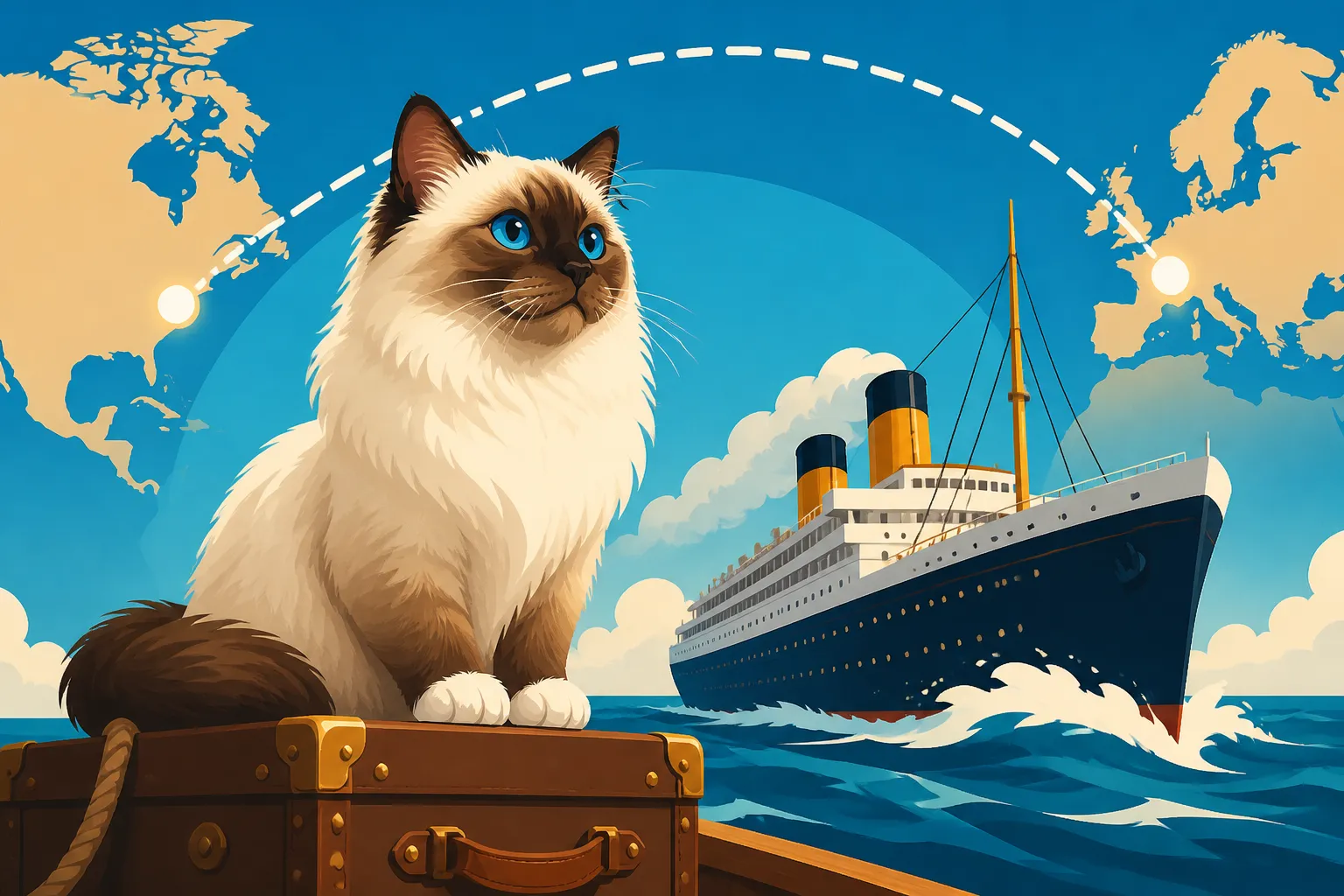
The Birman’s arrival in America was not a simple case of a popular European cat catching a boat west. The breed had first been rebuilt after near-disappearance in wartime Europe, so its Atlantic crossing depended on a small number of carefully chosen cats and breeders willing to establish new lines overseas. Here’s how the Birman moved from France to the United States—and why that journey still matters to its history.
The Birman was rebuilt before it crossed the Atlantic
From near-loss to a renewed European breed
The Birman’s story in America begins with a crisis in Europe. The breed was established in France before the Second World War, but the conflict left its numbers so depleted that breeders could not simply resume producing purebred litters from a large, healthy population. A few cats survived, but too few to rebuild the breed without careful planning and, at first, outcrossing.
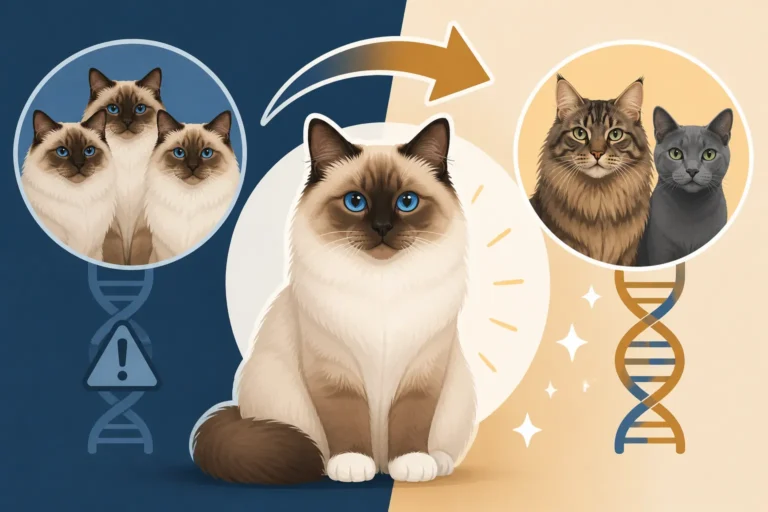
The postwar recovery is often described through two cats, Orloff and Xenia de Kaabaa. They became central to the rebuilding effort, alongside other cats used in the European breeding programs. Their descendants helped restore the Birman, but the narrow foundation meant that the gene pool remained small. The breed’s later success across the Atlantic rested on European breeders first making it possible for recognizable Birman lines to continue.
That background helps explain why an overseas export mattered so much. A new country meant new homes and new breeding possibilities, but it did not erase the limited ancestry behind the cats. For more on the fragile recovery that preceded the journey, see The Birman Came Out of the War With Two Cats Left and Which Two Cats Rebuilt the Birman.
Why sending Birmans overseas required careful choices
Exporting a breeding cat is different from sending a pet to a new home. A breeder choosing cats for an international journey needs to think about more than a striking coat or charming temperament. The cats must represent the breed well, have sound health, and fit into a breeding plan that can preserve recognizable traits without unnecessarily narrowing the population further.
That was especially important for the Birman. Its defining appearance—the pointed coat, blue eyes and white feet—had to be maintained as the breed spread. At the same time, breeders needed to pay attention to pedigree relationships. A small number of imported cats can establish a visible presence quickly, but if their descendants become the only source of breeding stock, that success can bring new risks.
The history of the Atlantic crossing is therefore also a story about continuity. The cats arriving in America were part of a European recovery already shaped by wartime loss and outcrossing. Why Birman Breeders Had to Outcross explains why that step was necessary before the breed could be re-established, while Which Longhairs Rebuilt the Birman After 1945 provides more context on the cats and breeding choices involved.
How the Birman reached the United States
The late-1950s imports
The first Birmans imported to the United States are generally placed in the late 1950s. Early American breeding history is associated with importers Elsie Fisher and Margaret Gentry, who helped bring the breed across from Europe and establish it as more than a little-known foreign cat. The exact details of early imports are sometimes compressed in popular summaries, but the central point is clear: a small number of European Birmans formed the starting point for organized American breeding.
Those first cats arrived in a country where the breed had no long-established local population. Breeders had to build recognition, find suitable mating partners, and introduce the Birman to registries and prospective owners. That process takes time. Even when a breed has a distinctive look, a few imported cats do not instantly create a stable, widely understood breed community.
The small scale of the early imports also made each cat’s pedigree important. American breeders needed to understand where their cats came from and how the new lines related to one another. If you’re interested in the people and breeding program linked with those first arrivals, see Which American Cattery Imported the First Birmans.
A small beginning, not an instant boom
It is easy to imagine an imported breed spreading quickly once people see it, but the practical work is slower. Breeders need to find homes for kittens, communicate what makes the breed distinctive, and build trust in the quality and ancestry of their cats. They also have to make decisions about which kittens to keep for future breeding and which are better suited as companions.
The Birman’s white gloves added another layer of attention. A kitten might have the familiar blue eyes and color-point pattern, but the shape and placement of its white markings could vary. Breeders establishing a population had to balance the breed’s visual identity with the need to make thoughtful choices about health, temperament and pedigree. The breed did not arrive in America as a finished, uniform product; its American presence developed through successive generations.
For someone comparing Birmans with other pointed cats, the outward similarities can be confusing. White feet are one of the details that help distinguish the Birman, but they are only part of its identity. How to Tell a Birman From a Ragdoll by Its Feet explores that visible difference, while The Gloving Gene Every Birman Carries Two Copies Of looks at the genetics behind the breed’s characteristic markings.
From imports to American recognition
Building a place in American cat breeding
Once Birmans were in the United States, breeders had to establish a recognizable population and introduce it to the country’s cat-fancy organizations. Registration and show recognition help turn an imported breed into a breed with a formal place in national cat culture. They also provide a shared framework for describing appearance and evaluating cats.
The process was gradual. Early breeders had to create interest, maintain records and demonstrate that their cats were part of a coherent breed rather than isolated imports. That meant producing generations of kittens and keeping track of their ancestry. American interest grew through the work of breeders and owners who were willing to learn about a cat that many people had not encountered before.
The Birman’s path was not unique in requiring this kind of patient groundwork, but its history gave the task particular weight. With a small foundation population, preserving records and exchanging breeding knowledge mattered. For the wider story of how the breed developed in Europe before spreading abroad, see How the Birman Reached Germany and Britain From France.
CFA recognition and what it meant
The Cat Fanciers’ Association accepted the Birman for championship competition in 1967. Recognition gave American breeders a more formal platform for showing the breed and helped make its name and standards familiar to cat enthusiasts. It was a significant milestone, though it did not mean that the breed’s development was suddenly complete.
Championship status can help a breed gain visibility, but breeders still have to make careful choices across generations. A show ring rewards adherence to a standard, while a responsible breeding program also considers health, temperament and genetic diversity. Those goals overlap, but they are not identical. A visually appealing cat is not automatically the right choice for every breeding plan.
The recognition milestone also sits within a broader international story. Different registries and national cat organizations have their own histories of recognizing breeds and setting standards. The Year CFA Accepted the Birman for Championship follows that American milestone in more detail, and Which Registries Recognize the Birman Today explains how recognition differs across organizations.
What the Atlantic crossing changed—and what it did not
The crossing widened the breed’s community
Bringing Birmans to America expanded the number of people who could own, breed and show them. It also created a new setting for the breed’s development. American breeders could exchange cats and breeding knowledge with other programs, helping the Birman become an international breed rather than one known primarily in Europe.
That wider community did not mean the breed’s history reset at the ocean. Every American line still carried ancestry shaped by the European foundation and the postwar recovery. The Atlantic crossing opened a new chapter, but the earlier chapters remained written into pedigrees. Understanding that continuity helps explain why responsible breeders care about documented ancestry rather than relying on appearance alone.
A simple timeline makes the stages easier to keep straight:
| Stage | What happened | Why it mattered |
|---|---|---|
| Before the Second World War | The Birman was established in France | A European breed community and breeding history were already in place |
| After the war | Breeders rebuilt the population from very limited numbers | Outcrossing and careful selection helped the breed survive |
| Late 1950s | Early Birmans were imported to the United States | American breeding programs began from a small European base |
| 1967 | CFA accepted the Birman for championship competition | The breed gained formal visibility in American cat shows |
The practical legacy for owners today
For a modern owner, the transatlantic history may seem distant from everyday life. But it is one reason to ask about a cat’s pedigree and health information rather than choosing solely by photographs or coat color. A responsible breeder should be willing to discuss a kitten’s background and explain what records are available. Those conversations are part of understanding the breed, not an unnecessary complication.
The journey also reminds us that international transport is stressful for animals. A cat moving between countries needs appropriate travel arrangements, veterinary planning and a quiet period to settle after arrival. If you are bringing a Birman home, keep the first days predictable: provide a calm room, familiar food, water, a litter tray and somewhere comfortable to hide. Retailers such as Chewy can be one place owners look for familiar food or routine supplies, but the most useful starting point is to ask the breeder what the cat already knows and eats.
For a long-distance move, avoid changing several things at once. A cat that has just traveled may be unsettled even if it is normally placid. Keep its feeding routine steady and introduce new spaces gradually. If you need to replace a familiar food or litter, Chewy and other pet retailers may help you find suitable options, but check the product details and make changes gradually where possible. The goal is not to recreate an overseas cattery at home; it is to give the cat enough familiar cues to feel safe.
The Birman’s move across the Atlantic was a modest beginning with a lasting effect. A few imports helped establish the breed in the United States, and later recognition gave it a formal place in American cat shows. Yet the story remains tied to its European roots: the cats that crossed the ocean carried the history of a breed rebuilt from very few survivors. Chewy may be useful for ordinary settling-in supplies, but no product can replace the careful records, thoughtful breeding and patient care that helped the Birman travel from a fragile European population to homes across the world.
Disclaimer
This article is for general informational purposes only and does not constitute professional advice. Laws, prices and regulations vary by location and change over time. Consult a qualified professional for guidance on your specific situation.